7 Rules for Trading Meme Coins Without Blowing Up Your Account
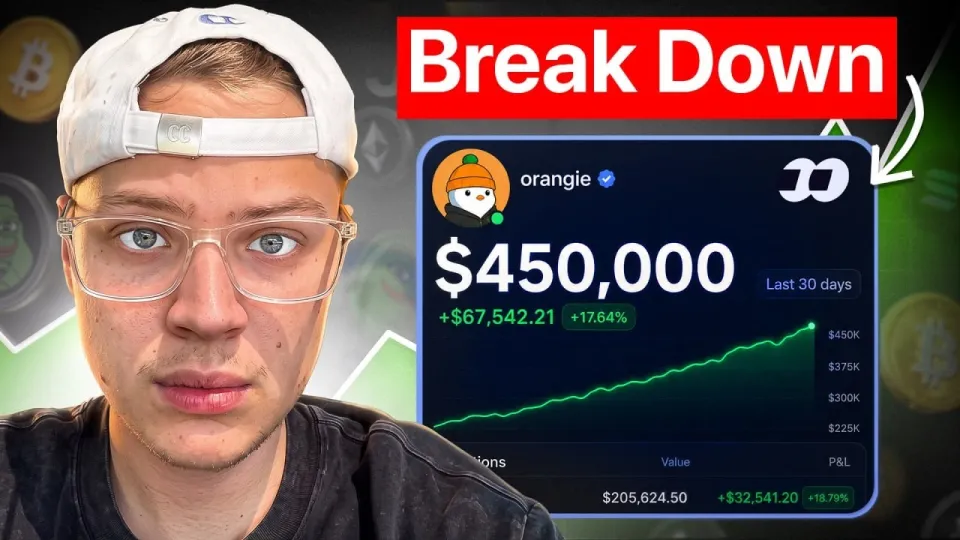
Video: How I Made $450,000 Trading Memecoins in 30 Days
Need articles like this for your video? They help promote it on YouTube and Google — order them in the Telegram bot @sat_sit_bot. It writes articles around your video, embeds the video and publishes them on popular niche websites (no ads). Try it free: 50 articles on us.
Key takeaways
- Meme coins are community-driven tokens on chains like Solana, priced purely by attention and liquidity — there is no cash flow, earnings or product behind them.
- A single winner can pay for many losers: traders routinely lose most of a small bankroll and recover it with one 3x–10x hit.
- Orangie Web3 documents a $450,000 result over 30 days in the video «How I Made $450,000 Trading Memecoins in 30 Days».
- Most retail losses come from size, not from picking: oversized entries on illiquid launches turn a normal -50% into a wipeout.
- Speed matters: on Solana, a token can graduate and dump within minutes, so pre-set exits beat improvised decisions.
A meme coin is a cryptocurrency whose value rests entirely on community attention, memes and liquidity rather than on revenue, a product or a team roadmap — which makes it one of the fastest-moving and most dangerous corners of crypto trading. In practice, trading them profitably is a risk-management exercise: you size small, take profits in stages, accept that most positions go to zero, and rely on one or two outsized winners to carry the month. The breakdown below is built around the approach Orangie Web3 demonstrates in the video «How I Made $450,000 Trading Memecoins in 30 Days», and readers who want the same toolkit can start with the Kaizen group access and trading resources linked by the channel.
What a meme coin actually is and why it moves so fast
A meme coin has no fundamentals to anchor a price, so its chart is a pure map of attention and order flow. On Solana, most new tokens launch through fair-launch platforms where anyone can create a pair in seconds, and the token trades on a bonding curve until it reaches a liquidity threshold and "graduates" to a decentralized exchange. That structure explains the behaviour traders see daily: vertical candles on a single influencer post, a slow bleed when the timeline moves on, and brutal -80% wicks when early wallets exit into thin liquidity.
Because supply is fixed and float is tiny at launch, small buys move price enormously. A token with a $30,000 market cap can double on a few thousand dollars of buying. The same math works in reverse on the way down, which is why experienced traders treat every position as expendable capital from the first second.
Why one hit can pay for a dozen losses
The defining feature of meme coin trading is an asymmetric payoff distribution: most trades lose, and a small number return multiples that dwarf the losses. Traders in the space describe portfolios where nine positions bleed out and the tenth returns 3x, 10x or more — the AMC-style recovery one viewer described after losing roughly 90% of a $100 bankroll and then tripling what was left on a single coin.
That math only works if the losing trades stay small. If you put 50% of your bankroll into each idea, a normal losing streak ends the account before the winner arrives. The practical rule is to cap any single position at a fraction you can watch go to zero without changing your behaviour — for most people that is 1–5% of a dedicated, separate trading bankroll.
7 rules that turn meme coin trading into a process
These are the operating rules that separate a repeatable process from gambling, and they apply whether you trade Solana launches, graduated coins or larger-cap memes.
- Separate the bankroll. Fund a dedicated wallet with money you can lose entirely. Never mix it with savings, and never top it up mid-drawdown to "get it back".
- Size by loss, not by hope. Decide the maximum loss per trade first (1–5% of the bankroll) and let that determine the position size, not the other way round.
- Check liquidity and holder distribution before entry. A token with a handful of wallets holding most of the supply, or with liquidity under a few tens of thousands of dollars, can be exited only at a discount.
- Take profit in tranches. Sell a portion at 2x to recover the initial stake, then let the rest run. Recovering cost basis converts a gamble into a free option.
- Pre-set invalidation. Write down the price or market cap at which the thesis is dead before you buy, and honour it. Meme charts do not give second chances on illiquid names.
- Trade the narrative, not the logo. Coins pump when a story is spreading — a new meme format, a celebrity post, a trending ticker. When the timeline stops talking about it, the bid disappears.
- Log every trade. Entry, exit, reason, and outcome. Reviewing your own trades is how you learn which setups actually pay; several viewers specifically asked for exactly this breakdown of entries and exits.
How to read the risks other traders warn about
The most persistent criticism in the comments under profit videos is that successful traders sit in private groups where calls are shared and sniped together — meaning the audience sees the outcome but not the coordination behind it. That is a fair warning: when a coin is being called in a large group, you may be buying from the people who called it.
Other structural risks worth naming:
- Rug pulls and honeypots: contracts that block selling, or where the deployer holds most of the supply and dumps on buyers.
- Sniper advantage: bots buy in the first block of a launch, so retail entries are already late and priced accordingly.
- Graduation traps: a token that graduates to a DEX can still collapse minutes later if the initial buyers are the only liquidity.
- Attention decay: meme cycles compress. A format that worked last month can be dead on arrival.
None of this makes trading memes impossible; it makes position sizing and exit discipline non-negotiable.
What beginners get wrong in the first month
The first-month mistakes are remarkably consistent. New traders buy the top of a candle they saw on social media, hold a losing position hoping for a bounce, and then revenge-trade the remainder on a coin with even less liquidity. The result is the 90% drawdown pattern that shows up again and again in trader anecdotes.
The fix is unglamorous: start with a tiny bankroll, treat the first weeks as tuition, and copy the process rather than the picks. Watching someone else's trades and understanding why they entered and exited is more useful than following a ticker — which is precisely the feedback viewers gave, asking for entry, exit and reasoning to be explained rather than just the profit number.
Tools and workflow for Solana meme coin trading
A working setup is small: a wallet, a trading terminal or aggregator that shows liquidity and holder data, and a charting tool for market cap rather than price. Platforms built for fast meme trading bundle the launch feed, chart and execution into one screen, which matters because on Solana the difference between a good and a bad fill is often seconds.
The channel behind this analysis points viewers to its own trading stack, including the FOMO trading platform it uses on stream, a Discord community for meme coin traders, and updates on Instagram. Treat any referral link as a tool recommendation, not a signal service — the decisions remain yours.
Useful links
- Kaizen group access: https://whop.com/checkout/plan_GTFkEFh0JFpU8?a=orangie
- FOMO trading platform: https://fomo.family/r/orangie
- Discord community: https://discord.gg/memecoins
- Instagram: https://www.instagram.com/orangieyt/
Final takeaway
Meme coin trading is a high-variance business where the winners are decided by sizing and exits far more than by picking. The $450,000 result Orangie Web3 documents over 30 days is a real example of what the upside can look like, but the same mechanics produce the 90% losses beginners report — the difference is that losers stayed small and winners were allowed to run. Build a separate bankroll, cap every position, take profit in stages, and keep a log so the process improves instead of resetting. For the full walkthrough and the tools used, see the channel's Kaizen group access and the original video from Orangie Web3.
Questions & answers
How much money do you need to start trading meme coins?
You can start with a very small amount — some traders begin with around $100 purely to learn execution, charts and exits. What matters more than the starting size is that the money is fully disposable and that each position is capped at a small percentage of the total. Starting small lets you survive the learning phase, where losses are normal.
Is it realistic to turn a small bankroll into six figures with meme coins?
It happens, but it is a tail outcome, not a plan. The distribution is extremely skewed: most trades lose, and a handful of multiples carry the result. Traders who report large gains typically combine small position sizes, early entries and staged profit-taking — and they also absorb long strings of losses along the way.
Why do people say meme coin traders in private groups have an advantage?
Large trading groups share calls, coordinate entries and can move a low-liquidity token quickly, so by the time a coin is widely discussed, much of the early move may already be gone. Retail traders buying into a heavily called coin can end up providing exit liquidity. The practical response is to verify liquidity and holder concentration yourself rather than following tickers blindly.
What is the biggest mistake beginners make with meme coins?
Oversizing positions and refusing to cut losses. A normal -50% move on a small position is survivable; the same move on half your bankroll is not. Beginners also tend to skip profit-taking at 2x, which is the simplest way to remove risk from a trade and keep upside exposure.
Source: How I Made $450,000 Trading Memecoins in 30 Days · Markdown version